The Room That Projects the Pacific onto a Table
Beside San Francisco’s Cliff House, a walk-in camera uses mirrors and lenses to bring the moving ocean indoors.
Inside the Camera Obscura at San Francisco’s Cliff House, a live view of the coast falls onto a curved white table. Waves move across the image as they move outside. The picture is made by light passing through an optical system, with no recorded film to play back.
A Camera Large Enough to Enter
Floyd Jennings built the attraction in 1946 on the Cliff House observation deck. Light from the scene outside enters through equipment on the roof, where a mirror and lenses direct it down into the darkened room. A rotating assembly lets the view sweep around the surroundings.
The table’s curved surface receives the image. Darkness inside makes the projection easier to see, while conditions outside affect its brightness and clarity. Sunlight, clouds, and fog become part of the viewing experience because the system is using the scene as it happens.
The principle is much older than this building. A camera obscura forms an image by admitting light into an otherwise dark space. Artists used versions of the device as drawing aids, and the same basic relationship between light, lens, and image helped lead to photography.
An Attraction That Stayed
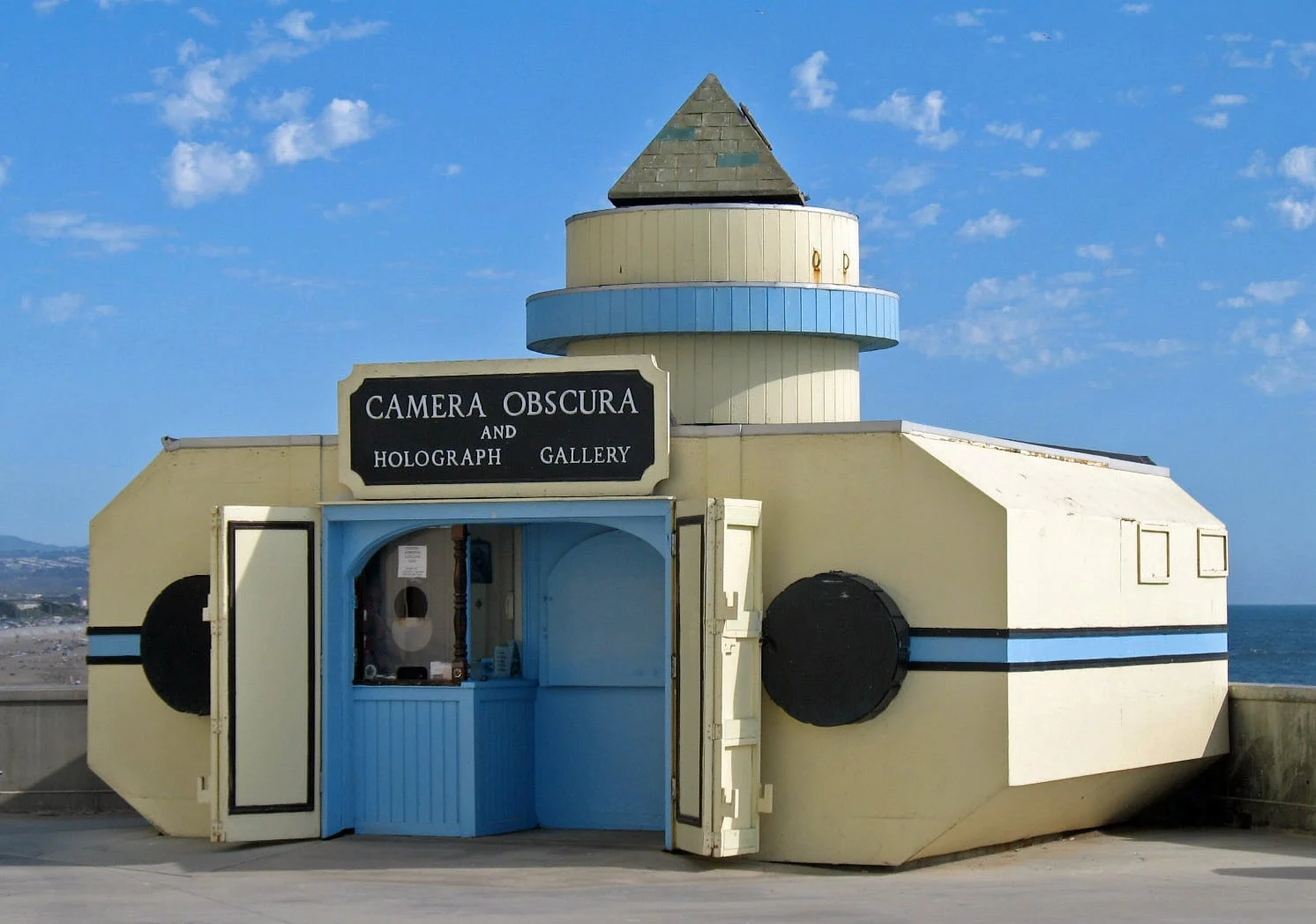
The Cliff House camera was built as an extension of the Playland-at-the-Beach entertainment area. Its exterior originally looked less like a camera than it does now. In 1957, it was remodeled with features that turned the small building itself into a giant camera-shaped advertisement.
The attraction remained after Playland closed in 1972. Other seaside amusements disappeared or moved, while the optical room kept its position above the shore. It entered the National Register of Historic Places in 2001 as a rare surviving example of its kind.
The building stands on the Cliff House terrace, overlooking the Pacific and Seal Rocks. It can be recognized from outside by its rounded forms and camera-like details. Interior access and operating conditions should be checked before a visit, particularly because the projected view depends on the light available that day.
Photographs from the 1950s show visitors gathered around the viewing surface. The projected image has no fixed running time: as long as enough light enters, the scene continues changing with the coast outside.
Keep exploring
Take these stories with you.
Open Hidden Here to see the stories around you. Choose a place on the map, read what happened there, or listen while you explore. Optional nearby alerts can point out stories you might otherwise miss.
Discover thousands of stories across the U.S.
Create a free account to read the full stories and listen to five of them. Passport adds unlimited listening.
 See how Hidden Here works

Sources & photograph
Adapted from the Hidden Here story catalog. Explore the historical records behind this story.