Omaha’s Temporary City of Palaces and Canals
For the 1898 Trans-Mississippi Exposition, Omaha built an illuminated fairground with classical buildings and gondolas on a canal.
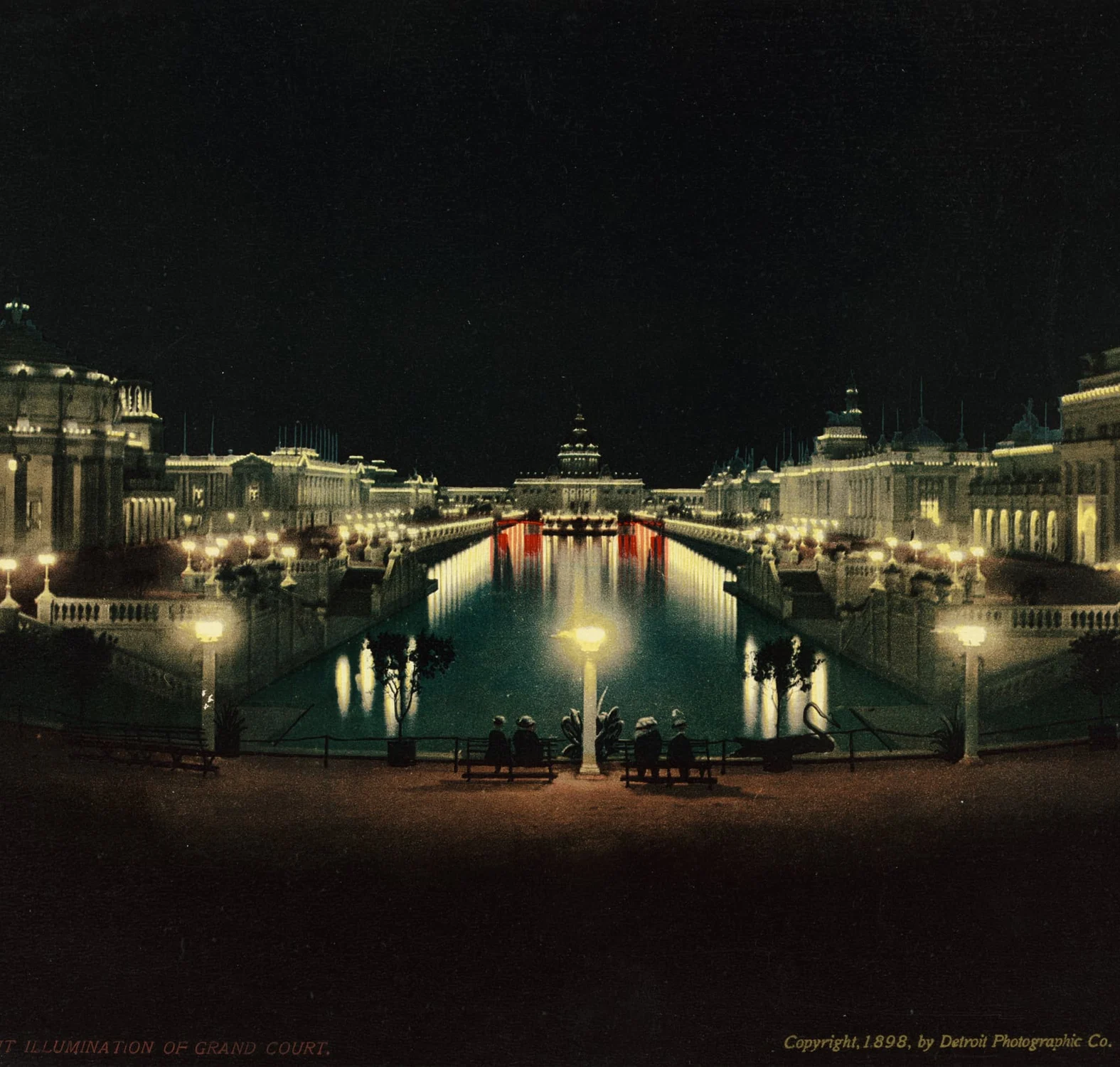
The night view of Omaha’s 1898 exposition shows illuminated buildings reflected in a canal. Gondolas passed through the Grand Court, surrounded by gardens, fountains, and large classical facades. The scene occupied ground that is now part of a residential area and Kountze Park.
Building a Fairground
The Trans-Mississippi and International Exposition opened on June 1, 1898. Its grounds covered roughly 184 acres. Organizers wanted to display the products and industries of states and territories west of the Mississippi, bringing exhibitors and visitors to Omaha on the scale of a world’s fair.
The Grand Court supplied the architectural centerpiece. Long rows of white buildings framed the water and open space. Their formal fronts suggested an established monumental city, although the fairground had been created for a short run.
Electric illumination changed its appearance after dark. Lights outlined the architecture and reflected in the canal, giving visitors another reason to remain into the evening. The surviving color view is a historical photochrom, a printed color treatment of a photograph, rather than a modern color photograph.
The Fair and the Neighborhood
More than two million people visited during the exposition. Exhibits covered industry, agriculture, art, and other subjects, while the Midway supplied amusement attractions. The grounds also hosted an Indian Congress, a separate gathering documented extensively in photographs held by Nebraska collections.
The main exposition closed on October 31. The Greater America Exposition used the grounds again in 1899. After that venture, the temporary structures were removed and the site returned to other uses.
Kountze Park occupies part of the former fairgrounds. It does not preserve the canal or a surviving row of exposition palaces. Photographs and plans are needed to place the elaborate court within the much quieter neighborhood that followed it.
The Nebraska State Historical Society holds the exposition’s records, including correspondence, directors’ reports, and guest registers. Those documents record the business of putting on the fair, while the night photographs show the setting visitors came to see.
Keep exploring
Take these stories with you.
Open Hidden Here to see the stories around you. Choose a place on the map, read what happened there, or listen while you explore. Optional nearby alerts can point out stories you might otherwise miss.
Discover thousands of stories across the U.S.
Create a free account to read the full stories and listen to five of them. Passport adds unlimited listening.
 See how Hidden Here works

Sources & photograph
Adapted from the Hidden Here story catalog. Explore the historical records behind this story.