Down Mount Tamalpais Without an Engine
The mountain railway’s gravity cars coasted downhill with passengers aboard and a brakeman controlling the descent.
An open car full of passengers rolled through the woods on Mount Tamalpais with no locomotive attached. At the controls, a railway employee worked the brakes. Gravity supplied the motion for the entire downhill trip.
Up by Steam, Down by Gravity
The Mount Tamalpais railway opened in 1896, connecting Mill Valley with the mountain above it. Its route wound around steep slopes in a succession of curves. A later branch served Muir Woods, giving visitors a rail journey into the redwoods as well as toward the summit.
Steam locomotives handled the climb. Beginning in 1902, passengers could make a downhill journey in small, open gravity cars. The cars were taken uphill by train, then released for the descent under the care of an operator known as a gravityman.
Passengers sat on benches in the open air. There was no enclosed coach or engine ahead of them. The track followed the same mountain grades and bends used by the steam trains.
The Brakeman’s Job
A gravityman controlled the car with brake levers that pressed shoes against its wheels. He had to manage speed continuously through the descent. Railway rules set a speed limit of twelve miles an hour for the cars.
The route from Mill Valley to the summit extended a little over eight miles, with a separate branch of nearly three miles to Muir Woods. All that track gave passengers a long descent, but it also gave the operator repeated curves and changes in grade to anticipate.
Automobiles gradually offered visitors other ways onto the mountain. A major fire in 1929 added to the railway’s difficulties, and its final passenger service ran that October. The tracks were removed the following year.
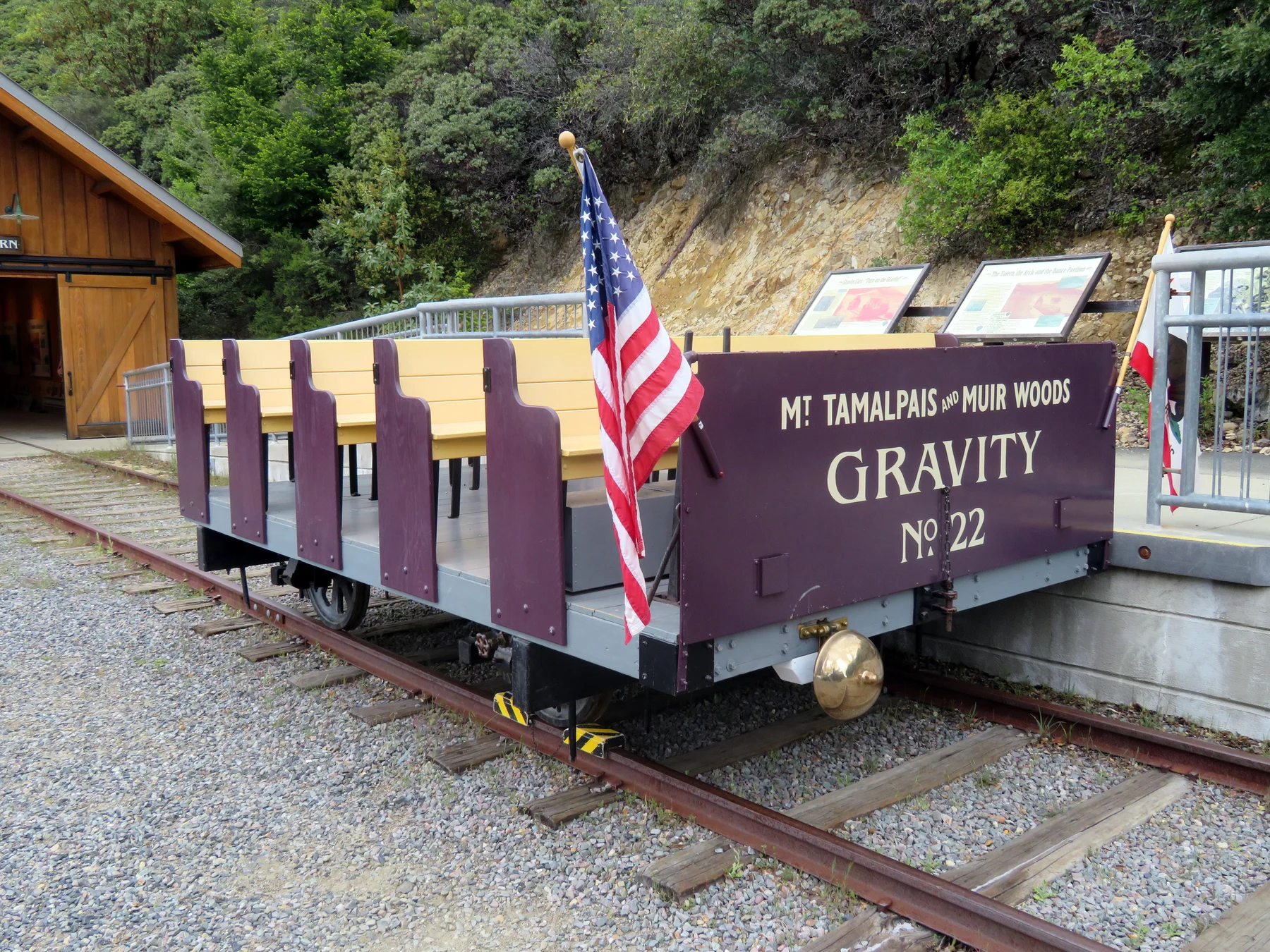
Near East Peak, the Gravity Car Barn preserves the story with exhibits and a recreated car. Much of the former rail route has become part of the mountain’s trail network. The display car has the same open arrangement of passenger benches, with the braking equipment at one end.
Keep exploring
Take these stories with you.
Open Hidden Here to see the stories around you. Choose a place on the map, read what happened there, or listen while you explore. Optional nearby alerts can point out stories you might otherwise miss.
Discover thousands of stories across the U.S.
Create a free account to read the full stories and listen to five of them. Passport adds unlimited listening.
 See how Hidden Here works

Sources & photograph
Adapted from the Hidden Here story catalog. Explore the historical records behind this story.