Detroit’s Movie Palace Parking Garage
A parking deck fills the Michigan Theatre’s old auditorium. The ceiling above it still belongs to a 4,000-seat movie palace.
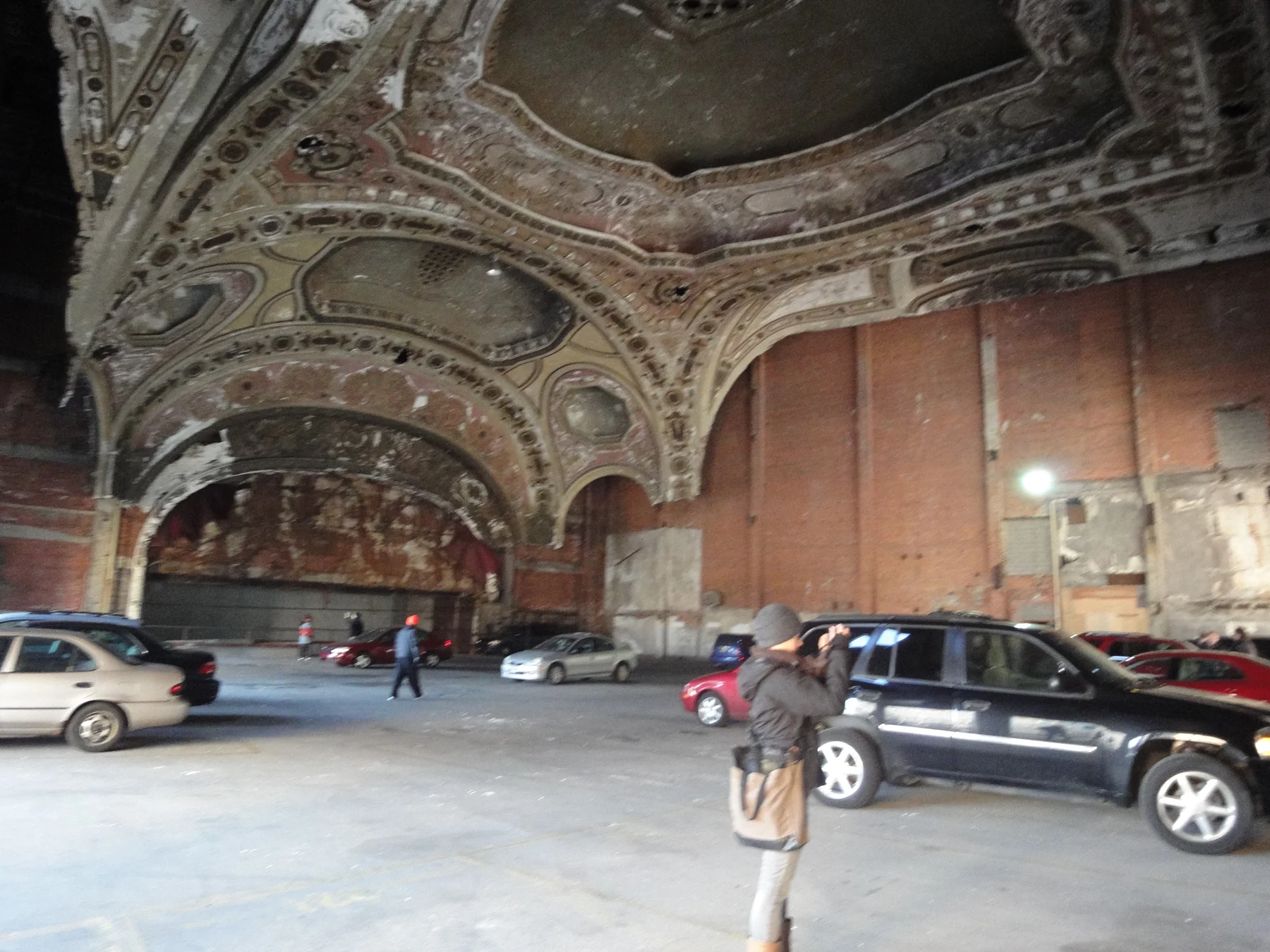
The cars inside Detroit’s Michigan Theatre park beneath a vaulted ceiling covered in ornamental plaster. A new floor cuts across the old auditorium, high enough to bring drivers close to details that moviegoers once saw far overhead. The screen and seats are gone. Much of the architecture remains.
An Evening at the Michigan
When the theater opened on August 23, 1926, its program combined movies with live entertainment, an orchestra, and a Wurlitzer pipe organ. Its French Renaissance interior was designed by Rapp & Rapp, the Chicago architects behind some of the country’s most elaborate movie houses.
More than 4,000 people could sit in the auditorium. Marble, chandeliers, and a vast lobby made the trip from the sidewalk to a seat part of the evening. These were working commercial spaces, with performances repeated throughout the day, built to accommodate crowds on a scale few neighborhood theaters could match.
The Michigan’s fortunes changed with downtown Detroit. Movie attendance declined, and its final film screenings came in 1971. That did not end its life as an entertainment venue. Rock concerts continued into 1976, adding another audience and another kind of noise to the auditorium.
A Floor Above the Seats
Demolition posed a practical problem. The theater was attached to an office building, and removing it risked affecting that structure. Converting the auditorium into parking provided a use for the enormous space while keeping its shell in place.
In 1977, workers stripped out seating and much of the lower interior. Three levels of parking were inserted into the former theater. The transformation was substantial: the surviving ceiling does not mean the auditorium remained untouched beneath it.
The resulting garage has a peculiar scale. Cars occupy the volume where audiences once sat, while fragments of arches and decorative plaster rise above ordinary parking spaces. From the upper deck, the ceiling is close enough for the wear, missing pieces, and remaining ornament to be plainly visible.
The Michigan still stands on Bagley Street. It is a working parking structure rather than a restored theater, so access depends on its operation. Photographs taken before the conversion show the full height of the auditorium, from its rows of seats to the vault overhead.
Keep exploring
Take these stories with you.
Open Hidden Here to see the stories around you. Choose a place on the map, read what happened there, or listen while you explore. Optional nearby alerts can point out stories you might otherwise miss.
Discover thousands of stories across the U.S.
Create a free account to read the full stories and listen to five of them. Passport adds unlimited listening.
 See how Hidden Here works

Sources & photograph
Adapted from the Hidden Here story catalog. Explore the historical records behind this story.