Learning to Sail on a Ship Built on Land
The USS Recruit trained Navy recruits on a concrete ship in San Diego. Its nickname was “Neversail.”
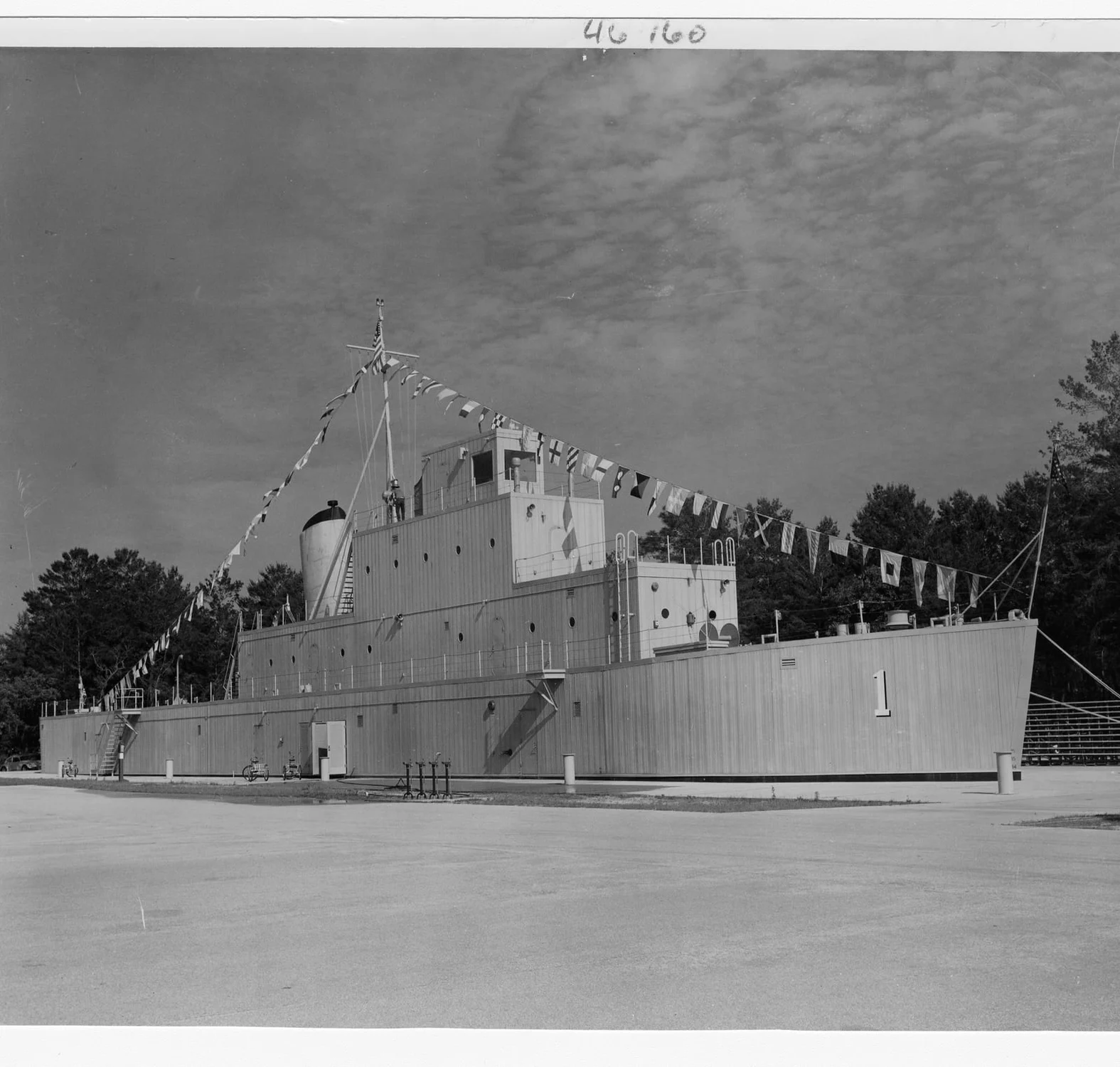
The USS Recruit has a bow, a bridge, and a mast, but no harbor beneath it. Built on land at San Diego’s Naval Training Center, the ship gave new recruits a place to learn procedures before they went aboard a vessel that could actually leave port.
A Ship for Beginners
Commissioned on July 27, 1949, Recruit was a roughly two-thirds-scale representation of a destroyer escort. Concrete made sense for a structure intended to stay in one place. The Navy needed a durable training environment with recognizable shipboard spaces and equipment.
Recruits could practice handling lines, follow commands, and learn how a ship’s different parts related to one another. For recruits arriving without maritime experience, the structure provided room to move through shipboard spaces and practice routines together.
Recruit’s landlocked position earned it the nickname “Neversail.” More than 50,000 recruits a year passed through its training program, according to Liberty Station’s history of the site. A fixed ship could serve successive classes without occupying a berth or taking an operational vessel out of service.
Changing with the Fleet
The model did not remain frozen in its original configuration. In 1982, it was refitted to represent a guided-missile frigate, bringing its appearance closer to the ships recruits would encounter in the contemporary Navy.
That alteration can make photographs from different decades look as though they show different vessels. Recruit was a training installation that changed with its job. The hull stayed on land while the equipment and structures above it were updated.
When the Naval Training Center closed in the 1990s, the surrounding property began its conversion into Liberty Station. The former base acquired new uses, but the training ship survived. It is the remaining example of three comparable postwar Navy training structures.
Recruit now stands among the buildings and roads of the former base. Its position makes the original arrangement easy to understand: generations of sailors first practiced shipboard routines here with dry pavement just beyond the rail.
Keep exploring
Take these stories with you.
Open Hidden Here to see the stories around you. Choose a place on the map, read what happened there, or listen while you explore. Optional nearby alerts can point out stories you might otherwise miss.
Discover thousands of stories across the U.S.
Create a free account to read the full stories and listen to five of them. Passport adds unlimited listening.
 See how Hidden Here works

Sources & photograph
Adapted from the Hidden Here story catalog. Explore the historical records behind this story.