
How Mitchell Puts Corn on the Palace
Artists plan the pictures, farmers grow the colors, and workers split the ears before fastening them to the building.
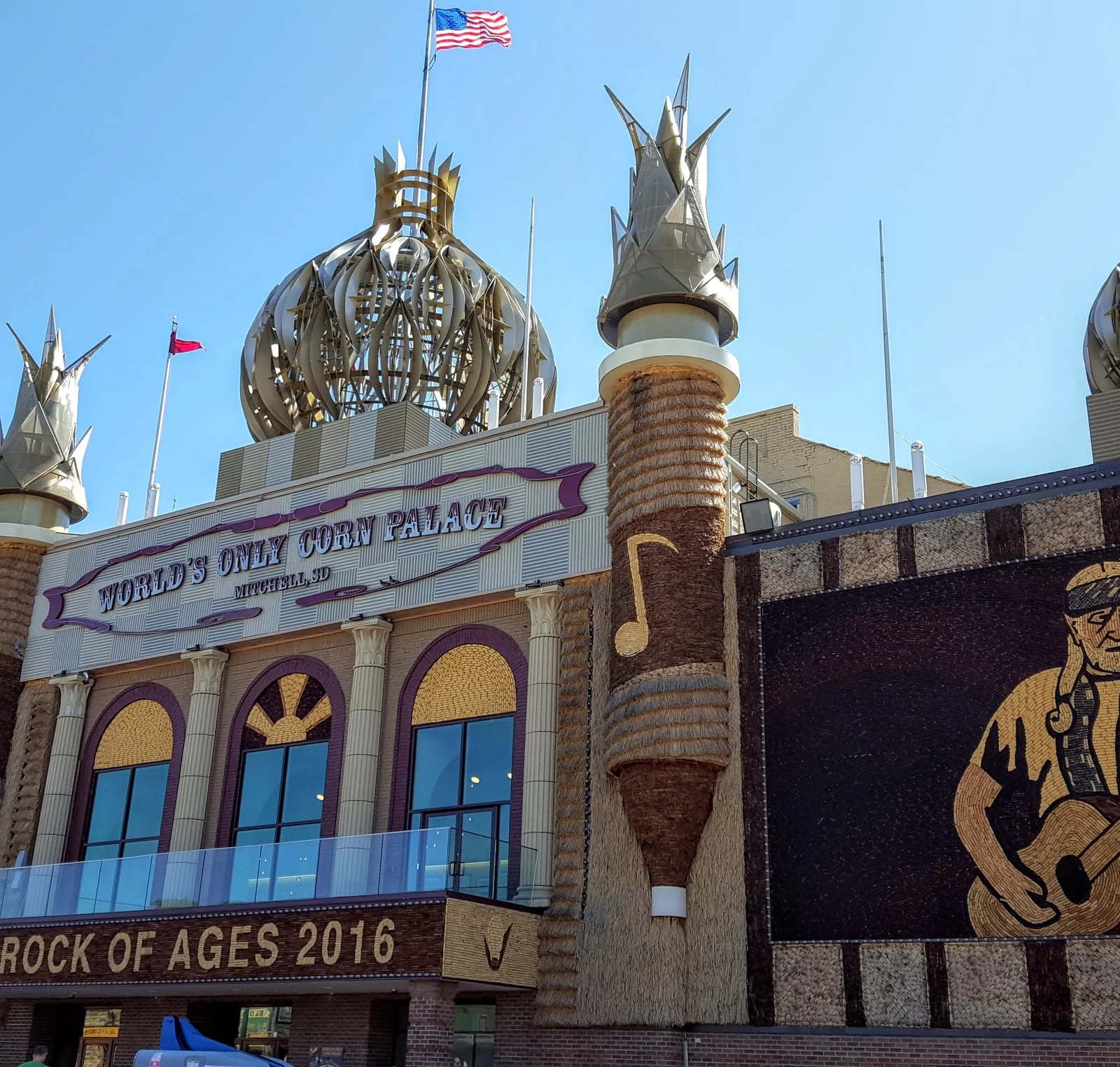
The pictures on Mitchell’s Corn Palace are assembled from crops. Ears of corn are split lengthwise and attached to the walls, with different natural colors filling out the designs. From across the street, they form large murals. Closer up, the individual kernels become visible.
Advertising a Farming Region
Mitchell built its first Corn Palace in 1892 to promote the agricultural possibilities of the surrounding area. Other Plains communities also made crop-covered exhibition buildings, using what their farms produced as both decoration and advertising.
The present building dates from 1921. Its domes and minarets developed through later work, while the interior served as an auditorium and arena. Basketball, concerts, and community gatherings gave the building jobs that continued after visitors had finished looking at the exterior.
The annual decorating work required a fresh supply of plant material. Corn, rye, and other crops had to be chosen, grown, harvested, and attached in enough quantity to cover large areas of wall.
From Drawing to Corncob
A mural begins with a design and a theme. The drawing is enlarged onto backing material, with areas marked for the colors that will fill them. Workers then fit the split ears into those spaces.
The palette depends on varieties of corn rather than paint applied to ordinary yellow kernels. Dark, pale, red, and other shades allow the decorators to form outlines and larger blocks of color. The cobs are fastened with nails, so producing the image is also a substantial construction job.
Removing and replacing the decorations takes place in stages. For part of the year, the building itself shows the process: finished panels beside areas being prepared for the next design.
Keep exploring
Take these stories with you.
Open Hidden Here to see the stories around you. Choose a place on the map, read what happened there, or listen while you explore. Optional nearby alerts can point out stories you might otherwise miss.
Discover thousands of stories across the U.S.
Create a free account to read the full stories and listen to five of them. Passport adds unlimited listening.
 See how Hidden Here works

Sources & photograph
Adapted from the Hidden Here story catalog. Explore the historical records behind this story.
