The Hope Diamond Arrived by Registered Mail
The Smithsonian’s famous diamond traveled from New York in a wrapped parcel. Its postage was $2.44, but its full mailing bill was much higher.
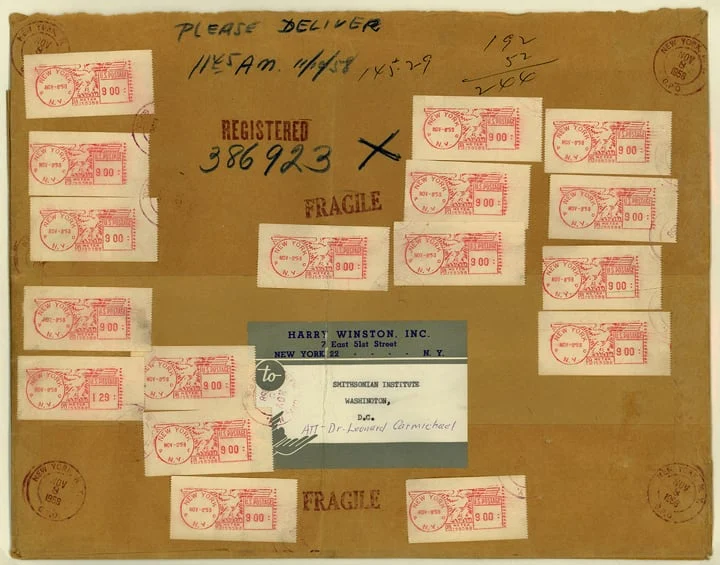
The brown wrapper saved by the National Postal Museum carried the Hope Diamond. In November 1958, jeweler Harry Winston sent the gem from New York to the Smithsonian through the United States mail.
Packing a Diamond for Washington
Winston was donating the diamond to the Smithsonian. He chose registered mail, with its controlled handling and record of delivery for valuable items.
The often-repeated postage figure is $2.44. That was only the postage. Registration and insurance charges added $142.85, bringing the total mailing cost to $145.29. The parcel was insured for nearly a million dollars.
Its appearance was ordinary enough: wrapping, tape, stamps, addresses, and postal markings. The writing on the exterior recorded a journey through a system used for many kinds of valuables. The registration markings documented its handling along the way.
The package was mailed in New York on November 8. It traveled by train to Washington and passed through the city’s main post office. Postal employee James G. Todd carried it to the Smithsonian by car on November 10.
Smithsonian Secretary Leonard Carmichael signed for the delivery. The diamond entered the national collection, where it became one of the institution’s most recognizable objects.
At 45.52 carats, the Hope Diamond was already famous before this journey. The mailing wrapper records a much smaller episode in its history, down to the fees and handling marks that made the delivery possible.
The two objects are now associated with different Smithsonian museums. The diamond belongs to the National Museum of Natural History. The surviving packaging is in the National Postal Museum’s collection. A visit to one does not mean the other will be nearby or on display.
Keep exploring
Take these stories with you.
Open Hidden Here to see the stories around you. Choose a place on the map, read what happened there, or listen while you explore. Optional nearby alerts can point out stories you might otherwise miss.
Discover thousands of stories across the U.S.
Create a free account to read the full stories and listen to five of them. Passport adds unlimited listening.
 See how Hidden Here works

Sources & photograph
Adapted from the Hidden Here story catalog. Explore the historical records behind this story.