The Pots Stored at the Auto Repair Shop
George Ohr’s thin, twisted pottery spent decades packed away in Biloxi before an antiques dealer came looking for old cars.
In 1968, an antiques dealer visiting Biloxi to look for old automobiles encountered thousands of pieces of pottery. They belonged to the family of George Ohr, whose former pottery business had become an auto repair shop. Ohr had died fifty years earlier.
Clay That Folded Like Cloth
Ohr learned the potter’s trade in New Orleans and established his own shop in Biloxi. He made useful wares for sale, but he also pushed clay into forms that were difficult to classify. Walls became exceptionally thin. Rims folded, bodies buckled, and handles curled away from vessels that seemed almost too delicate to have survived the kiln.
He used the name “Mad Potter of Biloxi” to advertise himself. His shop and his appearance attracted attention, and he promoted his work at exhibitions. His more experimental pieces sold poorly, even when other potters admired them.
Jugs, mugs, flowerpots, and souvenirs helped support the business. The unusual vessels that later made his reputation were another part of his output, and he was reluctant to sell his best work cheaply.
Fire and Exhibition Sales
A fire destroyed Ohr’s pottery in 1894. He salvaged damaged pieces and rebuilt, giving the new shop a tall, pagoda-like tower. Tourists returned to watch him work and buy souvenirs, while he continued making the more difficult pieces for which he wanted recognition.
At the 1904 exposition in St. Louis, he received a silver medal for original art pottery. He also failed to sell the hundreds of pieces he exhibited there. Praise from other potters and critics did not necessarily bring customers willing to pay his prices.
The Collection Left Behind
Ohr stopped making pottery in 1909. Thousands of pieces were packed away as his sons developed an automotive business. He died in 1918, leaving a collection that remained largely outside the art market for decades.
James W. Carpenter, the New Jersey dealer who encountered the stored pots in 1968, subsequently bought the collection. As pieces began appearing in galleries and collections, scholars and buyers reconsidered work that had been made long before it looked fashionable to them.
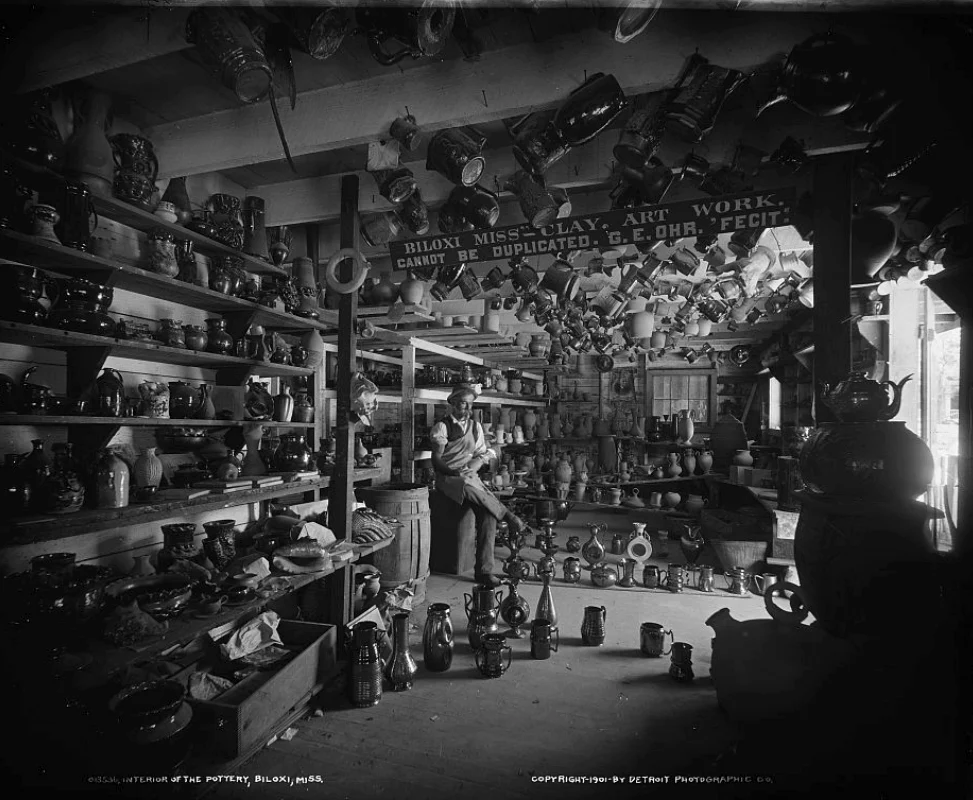
Biloxi’s Ohr-O’Keefe Museum of Art now holds examples of the work. It is a museum collection, not the original repair shop. The old workshop photograph shows a crowded room of pots and shelves, while the surviving vessels let visitors examine the thin walls and folded surfaces individually.
Keep exploring
Take these stories with you.
Open Hidden Here to see the stories around you. Choose a place on the map, read what happened there, or listen while you explore. Optional nearby alerts can point out stories you might otherwise miss.
Discover thousands of stories across the U.S.
Create a free account to read the full stories and listen to five of them. Passport adds unlimited listening.
 See how Hidden Here works

Sources & photograph
Adapted from the Hidden Here story catalog. Explore the historical records behind this story.